|
Re-published from "Neuroscience News" magazine from TechnologyNetworks. Original Press Release from Rice University At work, it’s healthier and more productive just to be yourself, according to a new study from Rice University, Texas A&M University, the University of Memphis, Xavier University, Portland State University and the University of California, Berkeley.
The study, “Stigma Expression Outcomes and Boundary Conditions: A Meta-Analysis” will appear in an upcoming edition of the Journal of Business and Psychology. It examines 65 studies focusing on what happens after people in a workplace disclose a stigmatized identity, such as sexual orientation, mental illness, physical disability or pregnancy. Eden King, a co-author of the study and an associate professor of psychology at Rice, said the decision to express a stigmatized identity is highly complicated. “It has the potential for both positive and negative consequences,” she said. However, the research overwhelmingly indicates that people with non-visible stigmas (such as sexual orientation or health problems) who live openly at work are happier with their overall lives and more productive in the workplace. King said self-disclosure is typically a positive experience because it allows people to improve connections, form relationships with others and free their minds of unwanted thoughts. BY THE PSYCHLOPAEDIA TEAM - THE AUSTRALIAN PSYCHOLOGICAL SOCIETY Many professions - paramedics, police, firefighters - involve helping people in traumatic circumstances but witnessing trauma has its own effects that can haunt people for life.
When we think about workplace safety, we often think about introducing or improving initiatives to ensure the physical safety of workers. In recent years, there’s also been a growing awareness around ensuring not just the physical but also the psychological wellbeing of employees, with more organisations now working to manage the impact of vicarious trauma in the workplace. While vicarious trauma will never be eliminated from trauma-exposed workplaces, it is possible for organisations to effectively manage it, which has been shown to reduce attrition rates and unplanned absences, and boost the workplace culture. BY JOSEPH PAUL FORGAS, SCIENTIA PROFESSOR OF PSYCHOLOGY, UNSW Photo source: Freepik The range of human emotions includes many more negative than positive feelings for good reason
Homo sapiens is a very moody species. Even though sadness and bad moods have always been part of the human experience, we now live in an age that ignores or devalues these feelings. In our culture, normal human emotions like temporary sadness are often treated as disorders. Manipulative advertising, marketing and self-help industries claim happiness should be ours for the asking. Yet bad moods remain an essential part of the normal range of moods we regularly experience. Despite the near-universal cult of happiness and unprecedented material wealth, happiness and life satisfaction in Western societies has not improved for decades. It’s time to re-assess the role of bad moods in our lives. We should recognise they are a normal, and even a useful and adaptive part of being human, helping us cope with many everyday situations and challenges. By Maria Tedesco - Clinical Psychologist Christmas, for some people, is a time for family, friends, gifts and holidays. It can also be a time for spirituality, reflection and prayer. Yet, for many it is a difficult time, and there are reasons why this may be the case.
Christmas can be a time of expectation and pressure. Families are supposed to “get along”, and this is not always possible. Some families have endured trauma or conflict amongst their members. There is nothing like the expectation and pressure of Christmas to place a magnifying glass on family feuds, fallouts and breakups. For some, who have experienced bereavement through loss, divorce or separation it can be a very difficult time. Often a Christmas without the person we once loved is a painful time, and a deep ‘solitary sadness’ can be experienced. We understand how important it is to provide real emotional and professional support to people experiencing a hard time during the Christmas holidays period. Clinical psychologists Teresa D’Amato and Maria Tedesco at Thinkwell Psychology are available for consultations during the Christmas period as follows: The team of therapists at Thinkwell Psychology is available for consultations as follows:
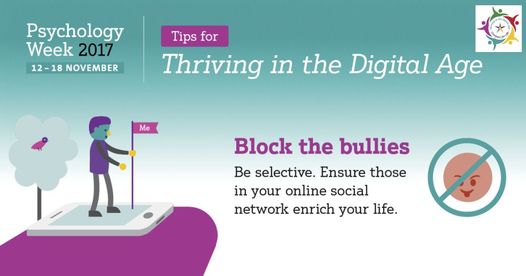
Bookings can be made by phone (6361 1275) or online. Anti-social behaviour online – trolling, cyberbullying – is a growing concerning phenomenon but research shows ignoring these mostly faceless angry attention-seekers could be the best response.
Almost half the population of the planet now has access to the internet, with about one in three of those people regularly active on social media. But this increased opportunity to socialise and communicate in a virtual environment has offered new avenues for antisocial behaviour. The problem of cyberbullying has received considerable research attention. However, other online antisocial behaviours with similarly harmful outcomes have received far less consideration – one example being anonymous online trolling.
Jocelyn Brewer MAPS introduces us to the concept of Digital Nutrition, an award-winning framework for teaching the principles of a healthy, balanced relationship with technology.
Digital nutrition borrows from the healthy eating pyramid and food nutrition principles to communicate key concepts around screen-time limits, digital citizenship and impulse control, and evaluates the cognitive benefits of apps and games. It is not about a digital ‘diet’ or ‘detox’, but about a positive, long term relationship with cyberspace that allows us to get the best out of technology, while avoiding the pitfalls of ‘internet addiction’. Are there healthy life choices for digital consumption? Are there digital superfoods? #psychweek
By Maria Tedesco - Clinical Psychologist
It is astounding that in a world like ours, where everything seems to be openly spoken about, there is a health crisis that is rarely mentioned, and that is loneliness.
Loneliness is defined as a state of ‘solitary sadness’. Studies show that it not only makes you feel miserable it can shorten your life. Loneliness is correlated to higher systolic blood pressure, cognitive decline and overall increases in morbidity and mortality (1,2,3). We generally think of loneliness affecting those with chronic agoraphobia or debilitating OCD but, loneliness is subjective. It can afflict even the most ordinary of people. It is a state of mind that can take hold when:
_____________ (1) Cacioppo,J.T & Hawkley, L.C. (2010). Perceived social isolation and cognition. National Centre for Biotechnology Information 3(10), 447-454. (2) Cacioppo, J.T et al. (2003) The anatomy of loneliness. American Psychology Society, 12(3), 71-74. (3) Perissinotto, C.M et al. (2012) Loneliness in Older Persons: a predictor of functional decline. Internal Medicine. 172(14), 10781084. |
Categories
All
|


RSS Feed